

Cautionary words and a tacit proposal
For 20 years, aggregate electricity demand in most of Europe barely grew. That means we haven’t had to think too deeply about how to power demand sources like data centres or factories. Most countries had a simple “first come, first served” system. You apply for a grid connection, take your spot in a queue, and the grid operator works through the waitlist sequentially.
Depending on where you want to connect and how much power you want, you might be asked to contribute to the cost of the supporting infrastructure, but the actual order in which requests are handled is fixed by the queue. This system is fine as long as the queue remains small and most of its inherent flaws can be ignored. Unfortunately, the recent demand surge from data centres has completely exploded demand-side connection queues in most developed countries.
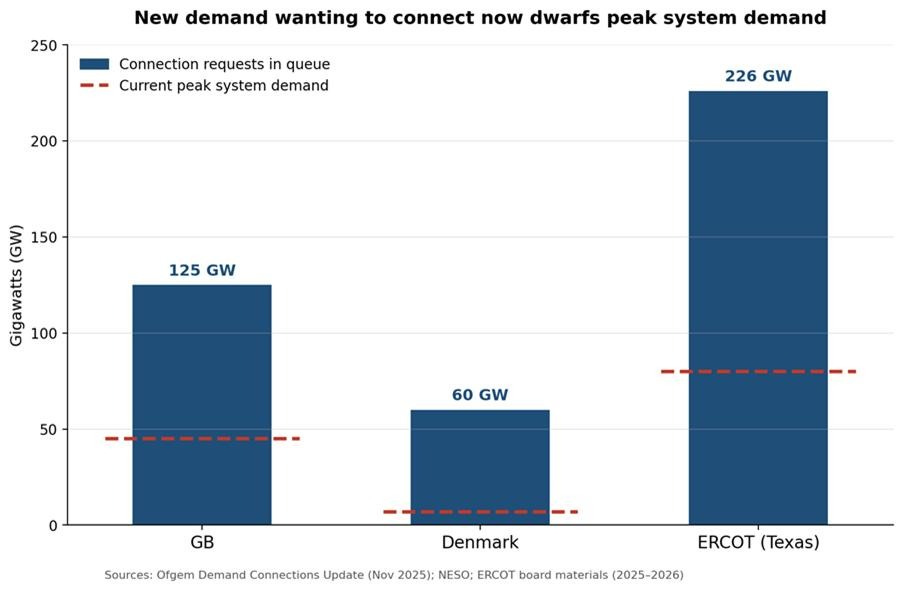
In hotspots like Texas and the UK, the assets waiting in the queue are actually several times larger than the total amount of demand in the system currently! With the pace of work that grid operators currently have (slow) and the macro effects from inflation, supply chain constraints and slow regulatory adaptation, a connection in an attractive location can often take 8-12 years now. Needless to say, that’s no way to generate economic growth. Many companies simply can’t credibly commit to specific factory / construction projects 12 years into the future given how fast the macro-economic environment can shift under their feet. All those projects instead just never materialise and don’t show up in our national economy.
Countries have taken notice and are implementing fixes or considering them, but I don’t think we should let a crisis go to waste on small tweaks. Before I unveil my grand vision, let’s understand everything wrong with the current system.
The connection queue – a laundry list of complaints
Fundamentally, a queue system treats every application equally, but in reality, connection applications differ wildly in merit. Some are much harder or costlier to accommodate than others, and a system should reflect this to incentivise everyone to make system cost-minimising applications.
The queue does not distinguish based on project quality
If a new data centre wants to get connected and we need to build a new substation and strengthen the local grid around it anyway, you’d really want those investments to happen in a place where they create spillover benefits. E.g. grid reinforcements and a substation near London is worth a lot more than somewhere in the Midlands. The queue approach does not prioritise projects based on system benefit rendered.
We have no way of securing “quick wins”
Two companies want to connect to the same substation. Oogle Datacentres, Inc. came first and has requested so much capacity that we have to upgrade the substation to accommodate them. This will take at least 5 years. Macrohard Computing Co. applied later but requests a more measured amount that we can accommodate without any upgrades today. A simple queue means we have to wait until the upgrades are finished before either company can connect. This is inefficient; we should be able to put Macrohard Computing ahead of Oogle to reward them for their measured ambition.
We are not rewarding good location choices
Managing optimal power flow on the grid is very difficult, and we should reward anyone who is making that job easier. The closer you can put power production and consumption to each other, the less that power has to navigate traffic jams in a tangled web of wires. For example, if you build a data centre powered by Quebec hydropower, you should put it as close to the dam as possible. If you put it somewhere in New England instead, the massive power draw from your data centre causes congestion on the grid for everyone else, necessitating more infrastructure upgrades. The queue system does not give quicker or privileged access to anyone willing to locate in ways that benefit the grid.
The queue encourages ghost applications
No one likes to be stuck in a queue, and energy developers are pretty sophisticated. They apply for grid access before they secure land rights, construction permits, or procurement, so they can secure grid access concurrent with securing permissions rather than starting the grid access clock afterward. The upshot of this is that the queue is full of speculative applications that don’t actually care or want to be connected if you held a gun to their head. The more developers engage in this behaviour, the more bloated the queue looks and the stronger the incentive to make even more speculative applications. As a result, the grid operator often has no idea how many projects in the interconnection queue are legitimate vs speculative and can’t effectively plan their infrastructure investments because the true scale of demand is unknown.
Current reforms are too timid and risk wasting a crisis
Grid operators are keenly aware of rapidly exploding demand interconnection queues. Many of them have had to deal with the mirror problem on the supply side (e.g., bloated queues for renewable energy wanting to connect) for years. In most countries, the grid queue reforms being implemented or discussed aim to make being in the queue more expensive to ensure only serious projects remain. This comes in the form of demanding steep cash deposits from developers, which are only returned if they actually build what they promise, or applying penalties for dallying around.
The UK is further than most and has implemented a “first ready, first served” system where developers that have all of their land rights and planning permissions sorted can jump ahead of others in the queue. This partially fixes the ghost application project and secures some quick wins but it misses the chance to take a swing at reforming the system more broadly!
Let’s make it an auction
The enduring lesson of policy design from the last 40 years seems to be that almost everything is better as an auction. Need to distribute radio frequencies? Auction! Need to efficiently allocate subsidies for renewables? Auction! Have a nationwide system of food banks and need to get food to all of them with no waste? You guessed it, it’s Auction time again! Grid access has the same problem shape where we need to allocate a socially desirable good in a way that efficiently uses state resources. Let’s walk through the proposal:
A public map of spare capacity
In many countries, developers fly blind without good data on where the grid has spare capacity and what upgrades are planned. That makes it hard for them to tailor their applications to grid needs! We should start by mandating that grid operators release public maps showing all spare capacity across their system and which upgrades are planned, and on what schedule. You can and should do this even if you’re not on board with all of the auction stuff!
Creating discrete connection offers
Next, grid operators take the spare connection capacity at each substation and slice it into individual connection offers. These connection offers would be pre-specified in respect to their (1) total capacity, (2) connection date, and (3) connection firmness. For example, if you have 1GW worth of space at a substation, you can turn that into 5 connections for 100MW and one connection for 200MW. Those connections are “firm,” meaning you can guarantee the customer can draw the maximum power whenever they want without causing system problems. We can’t guarantee this for the last 300MW of connection capacity at the substation. During periods of system stress, some connecting lines will likely be at capacity already and won’t be able to carry the 300MW to our substation. As a result, the grid operator takes this 300MW and makes a flexible connection offer out of it, which gives the grid operator the right to turn down the customer in question during times of system stress.

These connection offers can also be made forward-looking. A grid operator is upgrading a substation and knows it will have 400MW of additional capacity in 4 years. It can now create a set of connection offers starting in 4 years with that.
Going once, going twice, sold!
Now that we have a set of discrete products, we can run a bi-yearly auction where all interested parties can bid on the connections they care about. To further increase market efficiency, we can allow developers to trade connection offers after the auction. That way, a project that can’t deliver anymore for extraneous reasons doesn’t waste a valuable connection slot.
The grid operator can also run auctions to gauge interest in new developments and understand which infrastructure upgrades would be most valuable. When faced with the decision between building two different substations and transmission lines, they can auction the option for the capacity slots from both substations and see which one fetches a higher price and subsequently prioritize that project (you’d presumably return the money to anyone who bid for the project you decide against building). The grid operator gains valuable data and the winning bids get in on the ground floor of new-built capacity.
The benefits
The auction design has a lot of benefits over the current status quo. Let’s summarise the key ones:
Significantly improve speed to power - Any available capacity in the system right now is used maximally efficient and through auctions of connection slots it can flow to the most economically utile use-case. Compared to the previous system which had no good way of screening for the economic value of projects this is a big upgrade.
We uncover important information – The grid operator finally knows how much genuine demand there is and where it is concentrated. But this information is also valuable to developers. They have a much clearer understanding of what they will pay for a connection both in terms of time and money.
Grid operators can incentivise good behaviour – this finally gives us a good tool to reward developers for siting in the locations and with the flexibility requirements that are maximally useful for the grid in a tangible way.
Why should you be cautious?
I’m proposing a fundamental change to the plumbing of the energy system, so you’re right to be sceptical. There are two big caveats to this plan.
Utilities have messed up incentives, and this doesn’t fix them
Grid operators in most countries are regulated monopolies that have very strict rules around how they’re allowed to profit. Usually, profits are set as a percentage of capital or total expenditure. E.g., grid operators are allowed to recoup all of their costs and a little bit on top. This means that a grid operator has no inherent incentive to increase their customer base, they only have an incentive to increase their costs (insofar as the regulator lets them). Auctions do not fix this incentive alignment problem, and if implemented badly they could make things worse. If grid operators can easily profit from auctions, they might have an incentive to simply create persistent scarcity by underinvesting in the grid and raking in that sweet, sweet auction money. To fix this, we need a separate legal requirement for grid operators to connect clients as fast as they can or give them additional profit incentives for any new connections.
This doesn’t fix big-picture strategic planning
We can use the price signals from auctions for smaller-scale decisions like where to build additional substations and where to reinforce transmission capacity in the existing grid, but this won’t help us decide whether and where to build the long-distance high-voltage lines that make up the backbone of the grid. In 2005, Texas decided to build a connection “highway” to its remote western, wind-rich regions, which spurred significant deployment of renewables there. But this kind of investment is so large and essential for any demand or supply that projects in those regions will only start to materialise once we have built the groundwork for it. So grid operators will still have to make big picture decisions about the structure of the grid based on imperfect information and then auctions can help with the fine-grained allocation.
In Conclusion
The current system is clearly not able to meet the moment. Our choice is between limited band-aid fixes or utilising the need and potential for reform to align the connection allocation process with fundamental economic principles.
do you want backlash? because this is how you get backlash