
Put Up or Shut Down
Why is it so hard to connect Datacentres to the grid?

In my last post I focused on how Datacentres could engage in a mutually beneficial bargain with the grid and consumers by being a lot more flexible in their power demands and possibly a little more flexible in their spending too. Today we will consider the other side of the ledger: what has to happen on the grid side to make this work. Before we get into any gritty details (and trust me, we will), it’s helpful to understand the puzzle at the heart of the grid in 2026. This essay focuses on the UK as an example, but much of the same dynamics are shared across US and European grids with minor regional differences.
Why is there a problem to begin with?
Anyone who loosely follows AI and Datacentres knows that there is a massive power crunch in the US and western Europe with every hyperscaler under the sun absolutely desperate to get a grid connection while timelines for those have ballooned from 3-4 to 10+ years in attractive clusters. The UK had about 17GW of demand wanting to connect in 2024. Within just 8 months this had grown 7x to 125GW, which is almost twice the absolute peak demand on the system currently. At the same time, Denmark has seen demand requests equivalent to 9x its current peak demand, and Texas has gone from an already large queue of 63GW in 2024 to an utterly absurd 438GW in 2026. While it’s true that a good amount of this demand is spurious and the result of developers shopping around in different localities to try and get connected somewhere, even a reduction of 90% would make these connection requests historically unprecedented.
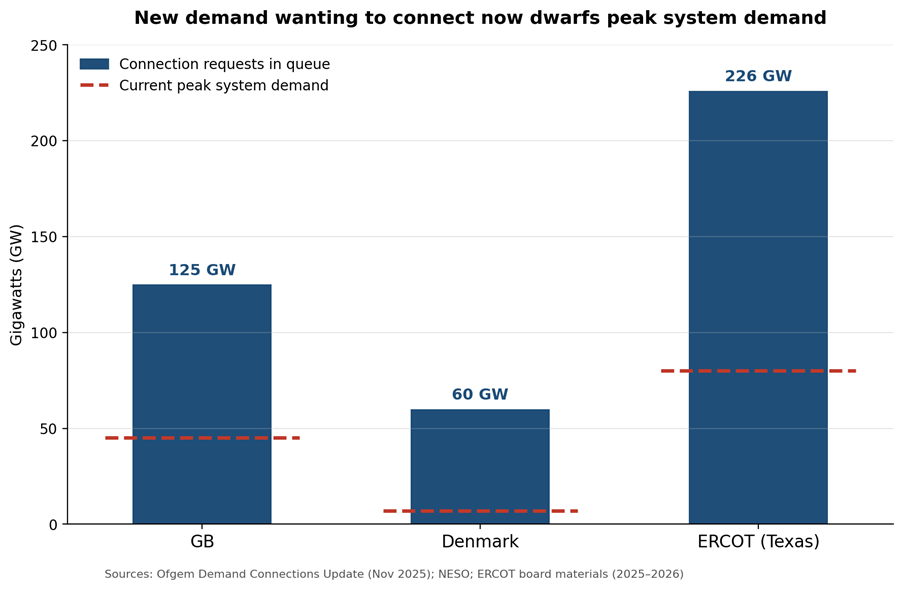
For any grid operator, this should be great news. Grids are nation-spanning infrastructure with large, fixed costs. The more load you can distribute those costs over, the more affordable your electricity becomes. This is doubly relevant in the context of the energy transition. If you’ve already committed yourself to build a whole lot of transmission lines and renewables, the political economy of this project becomes much easier when you have the additional demand to pay for it. In western Europe we have experienced a gradual decline in absolute power consumption for over 20 years now, despite population and economic growth. That has created a challenging environment where the fixed costs for maintaining national infrastructure gradually creep up power bills and make further investments politically toxic. All that is to say, European grids are staring at a generational opportunity right now to save them from a long malaise. But in good old European fashion, we are absolutely blowing it so far.
Of the 125GW of demand wanting to connect in the UK, the national grid operator NESO deems only 13GW to be realistically deliverable. And that’s their own optimistic projection! Everywhere across Europe, grid operators are announcing that there’s no space or spare capacity on the grid. Attractive datacentre hub locations in London easily see 10+ year timelines to connection. This is weird.
Remember that we just established demand has been decreasing for 20 years. Power plants and pylons don’t just disappear; their lifespan is measured in decades. So how can we have much of the same infrastructure, 5–10% lower demand, and somehow struggle to connect new customers? By all accounts we should have plenty of spare capacity and be perfectly placed to welcome datacentres with open arms. The rest of this post is my attempt at answering that question. I have lots of ideas but frankly a lot of this still puzzles me, so please chip in with your own thoughts and theories!
Part 1: the technical challenges
The curse of geography
The grids of the past, broadly speaking, put large point sources of generation (in the form of coal, gas and nuclear) in the vicinity of large demand sources like cities and industrial hubs. Unfortunately, this does not translate well to renewable-dominated systems. The best resources in terms of solar, onshore and offshore wind are often far away from population centres, both because they need larger amounts of land and because we don’t tend to build cities in especially windy places. This has two consequences. Our existing grid is not well suited to accommodate the power-flow geography of the future, and even if it was, we physically have to build a whole bunch more grid just to get far-away renewables to where the power is needed. Different countries and grids struggle with this to different extents. Germany and the UK both have their best renewable resources in the form of offshore wind in the north of the country, while most of the demand sits in the south. This creates enormous demand for transmission capacity that the legacy grid simply cannot meet, and now necessitates national-level infrastructure upgrades. Other regions have a better mix of solar resources all over the place and plenty of land to build onshore wind, which creates less pronounced geographic bottlenecks. Alas, we can’t exactly change the geographical cards we’ve been dealt, so what does this mean for our ability to connect lots of datacentres?
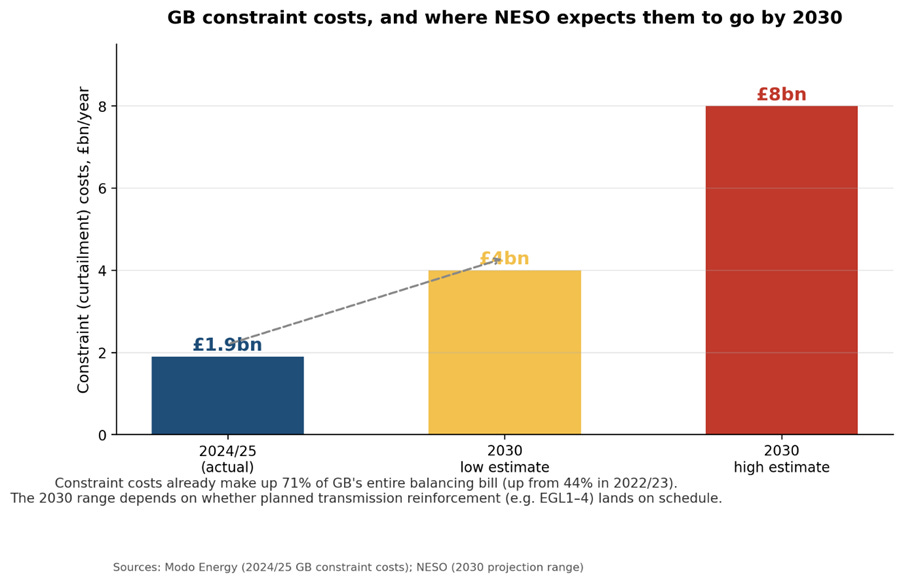
Figure 1 - NESO cost estimates for managing the cost of transmission system congestion
For constrained geographies like the UK, this explains part of our puzzle. We do have a lot of wind in Scotland and we do have a large existing legacy grid, but during peak demand much of the wind can’t make it south (the largest Scottish windfarm, Seagreen, is asked to shut off about 70% of the time because its power could not be physically delivered to where it is needed) and much of the grid was built to facilitate power flowing from coal power plants (now shut down) to northern industry (now located in China). The new problem of transporting Scottish wind to datacentres in London requires country-spanning, high-voltage DC lines, and like any massive government infrastructure project those take ~14 years and are subject to many of the problems we will discuss later in this post. Much of these bottlenecks are projected to disappear in the mid-2030s when the big transmission upgrades are meant to be finished. An example of this going well is Texas which spent $7bn on strategic transmission projects in the early 2010s to bring wind power from the western panhandle into the Dallas/Houston/Austin area. This meaningfully reduced bottlenecks, dropped wind curtailment from 17% to 0.5%, and is one of the reasons (though certainly not the only one) why Texas is a major destination for datacentres and load growth right now.
Stringent reliability standards
Grids in western countries are, for the most part, exceptionally reliable. In the UK, the “Loss of Load Expectation” (how many hours per year the system can miss its target, broadly speaking) is legally mandated at 3 hours per year. A stable expectation of power being provided consistently, with no blackouts and no questions asked, is an asset for economic growth and no doubt beneficial, but it turns out that it carries a significant infrastructure cost.
One of the rules ensuring supply stability for assets (but similar logic applies in other countries) is called an N-1 redundancy requirement. This means that if any given individual power line or substation catches fire and breaks, the system still has to serve all loads without disruption. Generally, this means that you want multiple available routes for power to flow to any given (large) customer, but here we collide with the reality of Datacentres. A modern AI datacentre consumes about 100x more power than those we built even 10 years ago.
This means that if you want to connect a Datacentre you will likely have to upgrade not just the substation closest to your datacentre and the transmission line that is meant to serve it but also another, redundant path to serve that same load. One example is a UK Datacentre cluster in Uxbridge. To accommodate 1.8GW of Datacentre demand trying to connect, National Grid is building an entire additional substation and upgrading lines in the wider region.
An additional complicating factor is that we’re talking about upgrades to an existing system with existing customers, who don’t appreciate it if you shut their power off while installing some new lines. Grid operators have to carefully schedule these repairs to make sure they are not creating a system risk themselves.
Many parts of our power grid simply were not configured to be redundant against very large individual sources of demand, instead of demand that is diffuse and evenly spread. All of this means that datacentres create a grid safety headache that requires upgrades and repairs on multiple levels, all of which carry their own delivery timelines, planning risks and supply chain exposure with them.
2. Supply chain risks and cost factors
The transformer shortage
Building power infrastructure takes a lot of specialised equipment which has in recent years become increasingly scarce. The biggest example of this trend is transformers (the large metal boxes with lots of odd rods in substations that are used to transform higher-voltage transmission currents into usable lower-voltage power for distribution). The average wait time for a power transformer is now about 2.5 years while more specialised orders can even take up to 4.
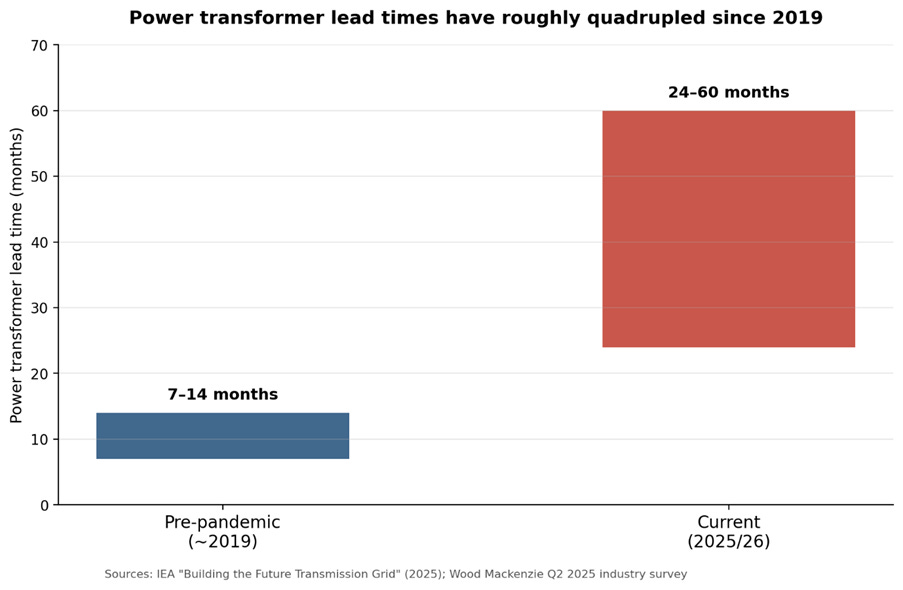
This bottleneck is fairly thorny and unlikely to resolve soon. To make a transformer you need special “grain oriented electrical steel” for which there is a limited global manufacturing capacity that has lagged demand for a couple of years now. Building more production capacity costs billions and takes years which is why producers are hesitant to invest, and bottlenecks persist for long times. While it seems to be the case that this bottleneck is less problematic in China, due to their domestic supply chain for electrical steel and transformers, this doesn’t help western grids in the short term because Chinese transformers are not certified for European or American standards and are additionally beset by concerns about national security. Transformers are also made bespoke for the demands of each individual project which makes it hard to create any form of strategic stockpile as a grid operator to ensure that projects can move ahead quickly. In effect this means that for any sizeable grid upgrade project, you have to assume a 2–4 year gap between planning approval and construction spent solely on procuring supplies.
Undergrounding and other kinds of gold plating
Beyond the direct supply chain concerns, cost is an additional driver of aggregate project delivery. If every single grid upgrade costs twice as much, the same amount of aggregate funding simply doesn’t go as far, or grid operators have to make tough choices about how many people they can hire to expedite deliveries. One culprit that unnecessarily drives up costs is laying transmission cables underground instead of using overhead lines hanging from pylons. It’s fairly intuitive that digging kilometres of trenches is more complex than building power poles but scale matters! Depending on how exactly you do the accounting, underground cables are 8-12x more expensive to build and about 5x more expensive on a lifetime basis than overhead lines. The connecting transmission line for the new Hinkley Point C nuclear power plant quoted costs of £16m/km for underground lines vs £1.8m/km for overhead ones, and would have required an additional £900m to underground the whole line.
It’s clear that this doesn’t pencil out, so why is anyone trying to put power lines into the ground? Largely, angry farmers and environmental regulations, it turns out. Undergrounding is often required when going through “Areas of outstanding Natural beauty” which make up ~20% of the country and are practically unavoidable for larger transmission links. While not strictly required in other cases, undergrounding parts of a line can be a negotiating tactic to appease local constituencies that would otherwise block planning permission, and is sometimes the only way that projects can survive protracted political opposition.
While it’s not the case that grid operators (at least in the UK) have a fixed budget — they instead recover infrastructure costs through levies on all consumer bills — there are both legal and political limits on how high those levies can go. High costs per project thus still mean a direct reduction in overall upgrades being performed, and hence less new capacity connected.
3. Planning and permitting
This section could be several blog posts on its own. Many other far more knowledgeable writers than me have written about all the ways in which the veto-point-laden UK planning system empowers NIMBYism, provides no incentives to build and chokes off economic growth. It’s unsurprising therefore that this malaise also ails the electricity sector.
Transmission projects are especially vulnerable since they produce no local benefits, tend to be especially offensive to rural communities and run across many individual counties, which can each create planning bottlenecks. One particularly troubling offender is the Beauly-Denny line in Scotland, which started applying in 2005 and racked up almost 20,000 individual objections, creating Scotland’s longest and most expensive public inquiry, until it was finally completed in 2016.
The Norwich to Tilbury line in East Anglia, meant to bring newly built offshore wind to the south, is currently being hotly contested, with three separate affected county councils formally objecting. This is despite the project already having put 25km of the line underground, incurring significant costs.
These are just two examples of a general trend. Almost every major transmission line faces substantial local opposition, and to the extent that it’s legally possible, rural communities will fight transmission lines tooth and nail. The 2023 UK Transmission Acceleration Action Plan aimed to fix some of these problems by taking planning authority partly away from councils and including strict timelines about how long project applications can be appealed and how fast appeals need to be processed. While this is undoubtedly an improvement, it likely only shaves about 1.5 years off a project timeline. What still remains are the lengthy pre-application consultations that grid operators conduct with communities to soft-launch their ideas and pre-empt any political blowback (not that this usually works) and onerous environmental regulations that mandate undergrounding in protected areas.
Sometimes the existing regulation even results in outcomes that are so absurd that you can’t even blame them on local opposition per se, instead being driven seemingly by the rote application of rules by civil servants with no consideration for cost-benefit calculations. In 2014, National Grid committed to spending £500m on putting existing transmission lines in Areas of Outstanding Natural Beauty underground. This did not create any new lines or upgrade existing lines in any way that matters for the grid, while representing a major cost to rate-payers.
In another case, a line near Dorchester had to delay construction for 20 months to allow for archaeological investigations to make sure that no significant finds would be overlooked before building. There are times when a country may choose to wait 1.5 years for important grid upgrades because it values possible Roman ruins just that much, but a generational opportunity to reverse demand shrinkage and fund the infrastructure of the energy transition might not be that time.
4. Regulatory problems
A disordered queue
I mentioned the ballooning demand queue at the top of this piece with the caveat that not all of the demand is realistic. The reason for this is that it used to be standard practice for most grid operators to treat the queue in a naïve sequential manner and simply connect the applicants in the order in which they applied. This makes a queue spot quite valuable to developers, and because there were few penalties for submitting speculative and clearly immature bids, many developers submitted a range of interconnection requests for different locations in the hopes that one would be successful — in which case they’d then commit to that project and drop their other requests. This is pretty terrible from the grid operator’s perspective because it obscures their visibility over how much genuine demand exists. It also causes grid operators to do a bunch of feasibility studies, cost estimates and strategic grid infrastructure planning for projects which in ~60% of cases never materialise.
This problem is not new and has actually existed for longer on the generator side with renewable developers often putting speculative bids for different development sites into the generator interconnection queue. The upshot of this is that we broadly know what to do about it and grid operators are slowly starting to apply the same measures on the demand side. These include asking developers to post bonds upfront to prove their seriousness, making queue spots contingent on projects actually meeting their development timelines, and reserving the right to remove projects from the queue that are not demonstrating a serious intent to deploy.
There are interesting ideas for further reform like auctioning grid connections off to raise further funds for grid operators and allocate resources efficiently but those have their own drawbacks (expect a separate blog on this when I get around to it).
Rigid standards instead of flexible connections
In my last piece I talked about all the possible benefits we could unlock from demand-side flexibility by datacentres, but this is a two-way street. To harness the sizeable upsides of greater flexibility, grid operators have to update standards, loosen some of their own rules, and create wholly new contractual structures and commercial offerings. In short, they have to be creative and risk-taking in a way they have not been in this millennium.
There are many specific ways in which this can go, but I want to highlight two specific high-leverage reform options, while noting that this is an open field for fresh ideas and encouraging everyone to participate in the wider conversation!
I mentioned the current N-1 reliability standards already. Currently our grid is run in a maximally conservative manner, where clients essentially have one product available: a super-reliable luxury option with all the bells and whistles. Unfortunately, it’s almost never in stock. If we accepted somewhat less reliability, we could unlock a good amount of additional capacity to come online. Maybe this is a bad trade, and no datacentre actually wants to be connected on more tenuous terms — but it’s at least a choice we should offer, and see what the market will bear, instead of making the choice for the market. One example of this is that current reliability standards are oriented around the nameplate capacity of the connection in question. So a datacentre that could theoretically draw a maximum of 400MW will necessitate grid strengthening to create a stable, redundant 400MW connection and wider reinforcement against the sudden loss of this demand. In practice, the vast majority of customers draw meaningfully less power than their full nameplate capacity at most times. If NESO was willing to apply probabilistic analysis based on actual usage patterns, it could secure the grid only against those nominal cases. We could even go one step further and drop the N-1 requirement, essentially saying “you have one grid connection; if that suddenly goes poof then you’ll have to wait until it’s repaired and suffer the downtime until then.” Is this worse than current connections? Definitely! But is it preferable to not being connected for 8 years? Quite possibly!
I want to be clear in distinguishing here between upgrades to the grid to ensure wider system stability versus those that insure the individual asset against loss of load. System-wide stability is crucial and cannot be sacrificed, but asset-specific security is ultimately an expensive luxury that we might be better off ditching in some cases.
The second idea concerns flexible connection agreements. This goes a step further than standards that concern anomalous events like a transmission line catching fire and going down; instead it concerns moments when the transmission grid is congested and struggles to properly serve all demand. A flexible connection agreement could, for example, say that the grid operator (with a notice period of 24 hours) can throttle or turn down the customer by X% of their demand. This would be capped at a maximum number of turn-down hours per year. A widely discussed study last year found that in Texas, we could add an additional ~20GW of demand if that demand was willing to be curtailed for just 2.5% of hours in the year — so even a small amount of operational downtime can unlock significant system benefits. Flexible connection agreements are not a totally new idea. They have been trialled in a couple of places, like the Netherlands and many other operators are actively thinking about how to make them work. The Federal Energy Regulatory Commission in the US (FERC) has instructed all of its independent system operators to introduce flexible tariffs for large loads like datacentres, so the momentum is clearly visible. Currently 77 different large-load tariffs are pending or implemented in US states with the number growing.
Unfortunately, regulators, operators and utilities are slow-moving beasts, not generally known for fast implementation speeds, which means that in many regions we still don’t have clearly defined contractual structures for how a flexible agreement could look, or clearly articulated visions from grid operators on how they want to structure these agreements. Greater demand side flexibility is a potentially powerful asset but it’s fundamentally a tool that has to be wielded well to work. Grid operators need to model the potential upsides this strategy could have for their specific situations, they need to develop clear strategies on how they would curtail demand and under which conditions, and most importantly, they need to do it fast. As I’ve outlined in my last post, the Datacentre industry increasingly has both the technical capacity to accept flexible connections and the economic incentives to do so. It is now incumbent upon the grid operators to enable this opportunity instead of squandering it.
Institutional inertia and decay
Every problem that I have outlined in this post so far (possibly except for the transformer shortage) is, in principle, solvable if enough agency and force of will is applied. The bigger question is whether ministers, Ofgem, NESO and the transmission operators can find within themselves the determination to see this through.
The power sector is fundamentally conservative, aimed at preventing outages and ensuring maximal reliability. It is also pretty sleepy. Electricity used to be a boring business of building large power plants which were operated in completely predictable ways, earning tightly regulated and modest profits. In other words, the sector presided over 20 years of stagnation. This already came up against significant problems when we tried to build record amounts of renewable energy without a clear national transmission strategy or plan on how to build a grid that could accommodate them. Now that we are also trying to connect unprecedented levels of demand at the same time, it’s clear that the current situation is untenable. Keep in mind that this is a sort of early warning alarm bell. Most energy transition scenarios see European power demand doubling by the 2040s due to electrification of transport, heating and industry. All of this was going to happen eventually, and in a way we got lucky that the AI boom, with its sudden surge in demand, has exposed just how unprepared our grids are for a speedy and consistent expansion.
The current picture in the UK is one of fragmented authority and competing visions. We have a ministry for energy matters in the form of DESNZ, an “independent regulator” in the form of Ofgem that is meant to regulate energy companies, allocate licenses and police market rules, a system operator in the form of NESO, which is meant to operate the transmission grid; and a variety of regional grid operators that own and manage parts of the country’s network. Coordinating all of these entities is hard on the best of days, and it often leads to conflict and misalignment. To make matters worse, cross-regional transmission projects require joint ventures between different regional grid operators, introducing another possible layer for failure. When Ofgem tried to allocate funding for grid expansion in 2025, this was met with public rejection by regional operators. This may not be bad per se, but it points to a system with serious coordination problems that will default to stagnation unless spurred into action.
It’s clear that a cultural shift is needed across the board if the UK and the rest of Europe want to rise to the occasion. This starts at the ministerial level, with the willingness to make needed reforms to the planning and zoning system so that transmission can be approved and built quickly, without year-long legal battles or endless consultation periods. It continues at national regulators, with an emphasis on moving faster in defining new standards like flexible connections, and a willingness to re-think old standards of reliability that do not serve the current moment. Finally, the grid operators have to fully commit to implementation. This means scaling up existing engineering capacity and learning how to speed up project delivery. It also means a willingness to engage with individual clients to offer bespoke connection agreements, and an openness to seeking win-win opportunities even if they seem unconventional.
The challenge before us is enormous. We have to build five times more power lines in the next seven years than in the past 30. To be competitive, we have to halve transmission line construction time and connection speed for both generation and demand. At the same time, we will have to balance an increasingly flexible but volatile system that behaves in ways we have little experience with. Even so, the prize is too large to ignore, so we might as well try.